Batch update
The Batch Update function lets you update up to 1,000 devices at once using a CSV file containing valid device IDs.
It is primarily used to rename many devices or update metadata in bulk - saving you significant time compared to manual edits.
To use this feature, begin by exporting a list of devices that includes the _id field. You can do this via an Excel report-recommended if you're exporting thousands of devices-or directly from the UI using the Select Many "Export to file".
Batch Update is especially useful for:
- Updating device names
- Modifying metadata fields
- Applying structured updates across many devices efficiently

Batch Update or Batch Install? Both take a CSV and both can change devices that already exist, so which one you want depends on what you have.
Use Batch Update when the devices are already in Yggio and you are changing them: it works from an export, matches each row by the device's
_id, and only updates. It cannot create a device.Use Batch Install when you are installing, and when you still have the installation file: re-running that file updates the devices it created, so you do not need an export at all. See Updating existing devices.
Update devices, step by step
A batch update needs a CSV file that includes the unique identifier (_id) of every device you want
to change. The easiest way to get one is to export it from the platform.
-
Go to the Device List.
-
Optionally create or select a view to filter the devices. The fields included in the view are the fields that end up in the CSV file, so every field you intend to edit has to be in the view.
-
Use Select Many to select the devices you want in the update.
-
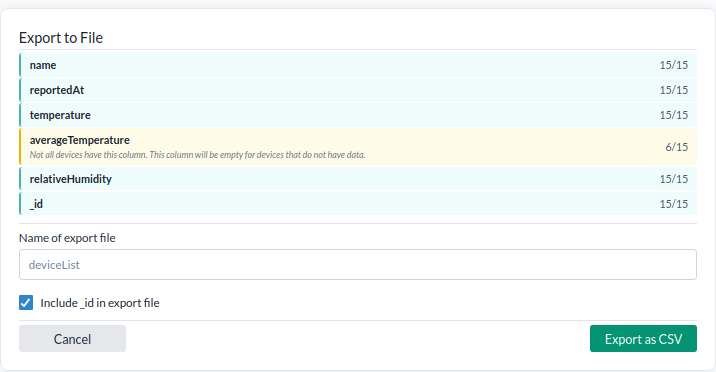
Choose "Export to file".
-
In the export dialog, toggle the
_idfield - the update cannot match devices without it. Two things happen on their own: thenamefield is always included, and translator columns are exported under the shorttranslatorX...names (for exampletranslator1.temperature) rather than the underlyingtranslatorPreferences.0.parameters.temperaturestructure. -
Choose a file name and select "Export as CSV".
-
Edit the file. See What you can change.
-
Go to the Batch Update menu in the platform and upload the edited file.
-
If the file has
contextMapcolumns, choose whether to add the parameters in your file or replace the device's parameters with them:Choice Effect Add The parameters in the file are merged into what the device already has. Parameters not mentioned in the file are kept Replace The device's contextual parameters become exactly what the file says. Anything not in the file is removed Choose Add unless you deliberately want to clear parameters that are not in your file. Replace is easy to trigger by accident when the export was made from a view that did not include every contextual parameter.
-
Start the update. Depending on how many devices you are updating, this can take some time.
What you can change
The platform will update or create fields based on the columns in your CSV file:
- If a column matches an existing field on a device, the value will be updated.
- If the column doesn't exist, the field will be created automatically, and the value you provide will be assigned to that device.
Editing the CSV is optional - but useful if you want to change names, metadata, or add new fields before uploading.
Below are just a few common examples of what you can do:
- Rename devices by editing the
namecolumn for each specific device - the most common use case. - Update metadata, such as:
- Who installed the device
- Which building or room it’s located in
- Installation date or tags
- Not recommended: Changing values like sensor data - this data is reported by the device and should not be edited manually.
- Add new fields - simply add a new column with values; the platform will create the field for each device.
- Remove any blacklisted fields if present -
reportedAtis the most commonly included. See Blacklisted fields. - Make sure the file remains a properly formatted CSV before uploading.
Translators
Translator columns use the same short naming as Batch Install: translatorXName, translatorXVersion, translatorXUpgradePolicy, and translatorX.[fieldname] for parameters, where X is a number from 1 to 4. Include only the columns for the translators and fields you want to change; a device's other translators and parameters are left as-is.
_id,name,translator1Name,translator1Version,translator1UpgradePolicy,translator1.protocol
6707091c22a62e0cf1713d15,People-Counter-1,my-translator,1.0.0,minor,lorawan
Contextual parameters
Contextual parameter columns are written as contextMap.[name], the same as in
Batch Install. Whether they are added to or replace what
the device already has is the choice in step 9 above.
Batch Update shows the same contextMap data types panel as Batch Install when the uploaded file has
contextMap columns. It lists each parameter with a sample value and the auto-detected type, with a
Force String toggle for the ones that should stay text. See
Data types and how to override them.
The CSV file
The file format, the accepted delimiters, the file encodings and the rules about spelling and case in field names are the same as for Batch Install. They are documented once in CSV file reference.
Two of those are worth knowing before you start:
- Field names are mostly case-sensitive. A miscapitalised column is not an error; it is treated as a new field and stored under that name, so the value does not land where you meant it to. See Formatting rules for the narrow set of names that are case-corrected.
- å, ä and ö are safe. UTF-8, UTF-8 or UTF-16 with a byte-order mark, and Windows-1252 / ISO-8859-1 are all read correctly, so a file exported from Excel on a Swedish locale keeps its characters.
Limits
- 1,000 devices per file. A larger file is rejected; split it.
- File size. A file can also be rejected for being too large in kilobytes even with fewer than 1,000 rows, because the whole update is sent in one request. The message states the size and the maximum. Very wide files, or long values, are what hit this - split the file, or update fewer fields at a time.
- Blacklisted fields cannot be updated. See below.
Blacklisted fields
The following fields are proprietary to the platform, and a file containing any of them is rejected with a message naming the ones it found:
rabbitRoutingmongoIdencodedDatarawDatareportedAt
reportedAt is the one that most often comes along by accident, because it is part of the default
device view and so lands in the export. Delete the column before uploading.