Warehouse racking
Racking is hit constantly and inspected occasionally. A forklift catches an upright at walking pace, nobody reports it because nothing visibly happened, and the next knock lands on a leg that is already weakened. The damage accumulates in the gaps between manual inspections, which is exactly where nobody is looking.
Three things follow from that, and they are the whole case for measuring:
- The damage is slow and silent. Repeated low-speed knocks weaken a rack over time without leaving a mark anyone would notice on a walk-round.
- It is found too late. By the time damage is visible you are looking at repairs and downtime, and in the worst case a collapse.
- Where monitoring exists, the data is often locked away in a dashboard of its own rather than in the WMS or ERP the team actually works in.
What is measured
Square Impact is not separate hardware. It is the Impact app running on Square Tracker hardware - the ruggedised Xtreme variant, whose IP68 and IK06 rating, integrated 4 Ah cell and 3D accelerometer are what the job needs. The unit mounts on the rack leg and reports impact, vibration, tilt and temperature.
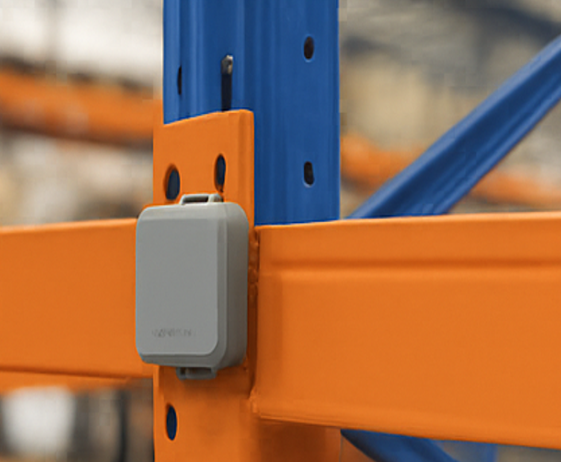
That matters for more than accuracy of description. The same device is an asset tracker with a different app on it, so a warehouse that already runs Square Trackers is not buying a new fleet, and a rack sensor can be re-tasked later without replacing hardware. Apps are delivered over the air; see App Upgrade and App Info and Config.
| Detection | 3-axis accelerometer - shocks, hits and abnormal vibration patterns |
| Battery | Event-driven 4 Ah cell, 10+ years. Fit once, no swap cycle |
| Range | LoRaWAN up to 2 km, so one gateway covers a site rather than a hub per aisle |
| Environment | IP68 and IK06 - waterproof, dustproof, impact-resistant |
| Location | Wi-Fi MAC scanning pins each impact to a place, in a building with no GPS |
| Setup | NFC, by tapping with an Android phone |
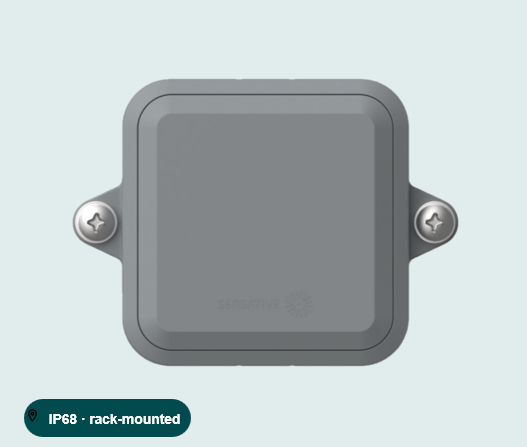
The hardware pages carry the full specification and are the authority on it; the figures above are the ones that decide whether the deployment works.
Event-driven operation is what makes the battery figure real: the sensor is quiet until something happens, so a decade of service is a consequence of the racking being hit occasionally rather than constantly.
Vibration is the part that predicts
An impact alarm tells you a rack was hit. That is useful, and it is not the interesting half.
The sensor also runs an FFT and reports vibration energy across nine bands from 1 to 256 Hz. Wear and looseness change that signature before anything fails, so the bands are what let a rack be taken out of service on evidence rather than after an incident. An impact alarm is reactive by definition; the frequency data is what makes the programme predictive.
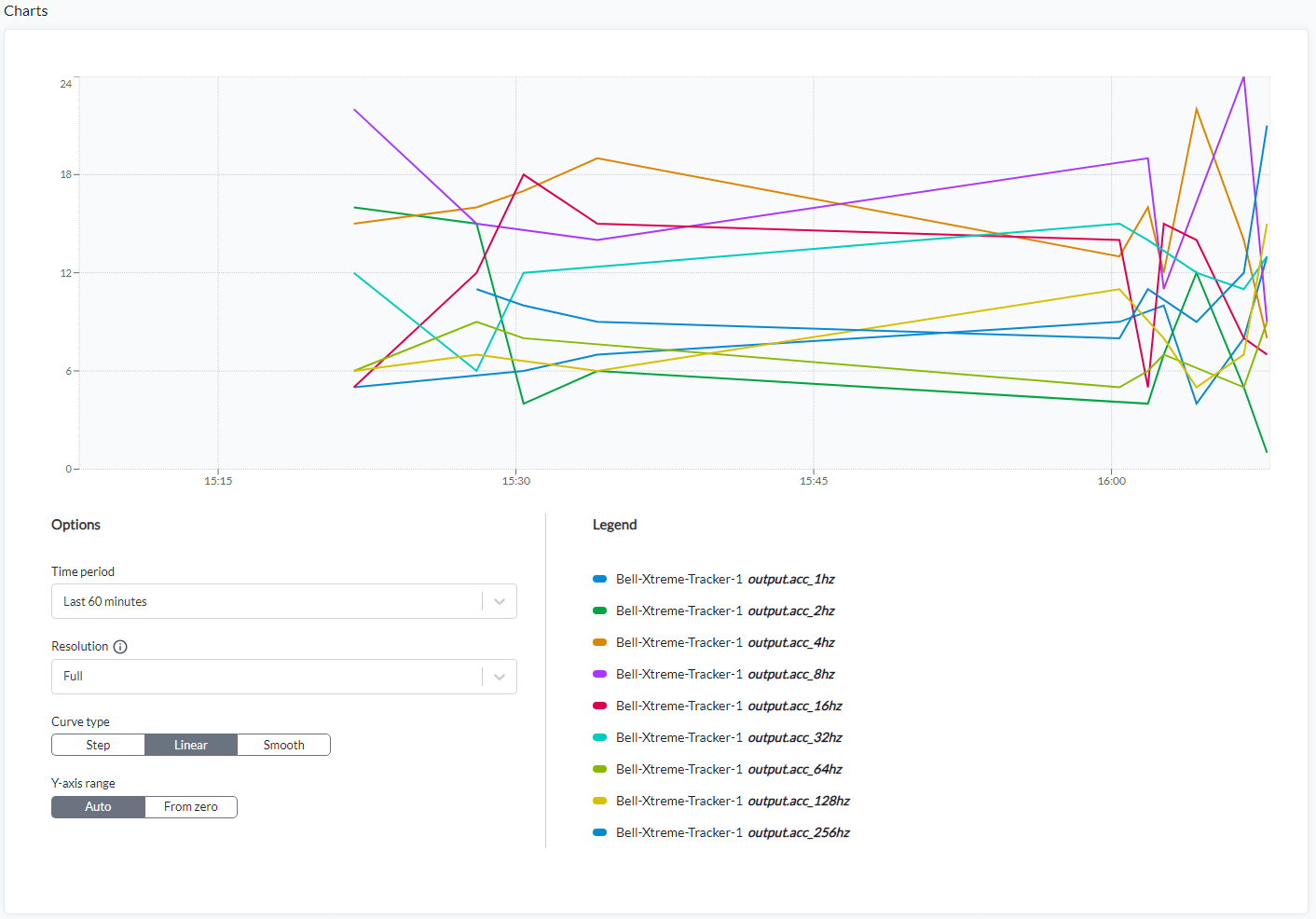
Each band arrives as its own field on the device, from output.acc_1hz up to output.acc_256hz, so
the bands can be charted, thresholded and trended like any other reading.
This is also where a rack that is quietly deteriorating separates from one that was simply knocked once. A single hit is an event. A drifting signature is a condition.
Where the data goes
The point of measuring is that somebody acts, and people act inside the systems they already have open. Rack health that lives in its own dashboard gets checked when someone remembers.
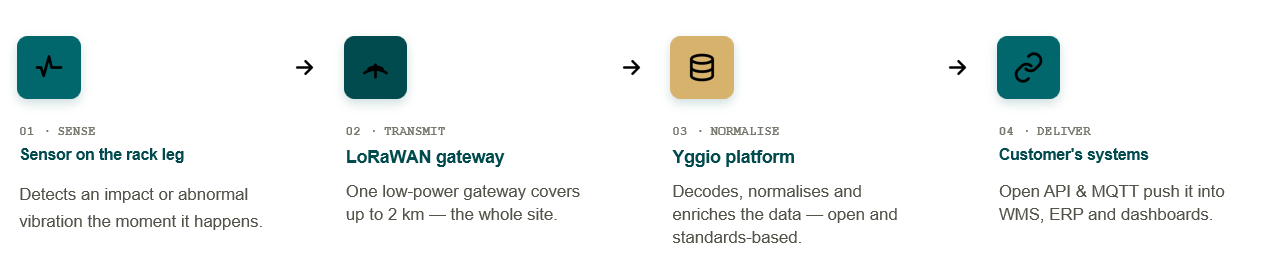
The middle step is the one that makes the last step possible. A translator turns the payload into named fields on an ordinary Yggio device, and from there the data is reachable the same way everything else is - one standardised interface rather than bespoke middleware per system.
- Into operations systems - WMS, ERP and facility systems over the open API or MQTT, so rack health sits alongside every other operational signal.
- Into reporting - Grafana and Power BI through the same interface.
- Into action - the Rule Engine decides what an impact above a threshold triggers: a work order, a message to the shift lead, an escalation if nobody acknowledges.
Because the data lands as ordinary devices, everything in the platform applies to it: access rights per site or per contractor, dashboards per role, and reports on a schedule.
Running it across sites
Warehousing is rarely one building, and the things that matter at fleet scale are unglamorous:
- One gateway per site, not per aisle, because 2 km of range covers a facility. The gateway goes where a network outlet already exists.
- Battery and link health tracked for every sensor, so one that has gone quiet is raised as a fault rather than mistaken for a rack that has not been hit.
- A shared hierarchy across sites, so an impact is reported as an aisle and a bay rather than a device identifier. Indoor positioning helps here, but the naming is what makes an alarm actionable at three in the morning.
- The data stays yours, on open FIWARE data models, running in the cloud, at the edge or on-premise.
How to get started
Low risk, and fast to a first result.
1 - Scope it in a conversation. An hour is usually enough to establish where the racking damage actually is, what the repair history says, and which of your own systems the data has to reach.
2 - Pilot one site, one set of aisles - the ones with the repair history, since that is where the case is made or disproved quickest. Small enough to fit around normal operations, and delivered into your live WMS rather than a dashboard of its own, so it is proof in your own environment.
3 - Scale across the remaining aisles and sites, on the same platform, naming and data model.
Worth confirming during the pilot rather than after it: that one gateway really does cover the site before you order sensors for it, and that an impact reaches the shift lead in the system they already have open. Then extend on the vibration trends after a full quarter - impacts justify the sensors, but the drifting signatures are what make the programme predictive.
Related
- Water leak detection - the same alarm and escalation pattern
- Rule Engine - turning an impact into a work order
- LoRaWAN - how the sensors reach Yggio
- Square Tracker Xtreme - the hardware the Impact app runs on
- App Upgrade - delivering the app to the device
- Other integrations - getting data out to other systems
- Asset tracking - the same trackers, answering where things are