Oil and other liquids
Far fewer sites have this problem than have a water problem, and the ones that do have it differently. A litre of water on a plant-room floor is a mopping job. A litre of hydraulic oil on the same floor can be a reportable event, a contaminated bund, or the first evidence that a machine is failing.
That changes what the sensor has to do. Detecting that something is wet is not enough, because these are places where something is often wet. The question is whether the liquid on the floor is the one that matters.
"Oil" is shorthand here. The sensor is selective rather than oil-specific: it separates liquids the absorber takes up - hydraulic fluid, lubricant, coolant, diesel and similar - from water, which the absorber turns away. If your problem liquid is not water, this is the sensor for it.
The sensor answers two questions, not one
Both Strips sensors detect liquid by capacitance, through absorbent pads that draw it in. The +Oil variant adds a second sensing area: one open to everything, so any liquid reaching the strip raises it, and one behind an oil-absorbing, water-repellent membrane, so water is turned away and only liquids the membrane takes up get through.
| Open area | Membrane area | What leaked |
|---|---|---|
| Alarm | Quiet | Water, or another liquid the membrane turns away |
| Alarm | Alarm | Oil, or another liquid the membrane takes up |
Comparing the two is what separates "something leaked" from "the wrong thing leaked", on the same floor at the same moment.
That distinction is not academic, and it is the whole reason a general liquid sensor fails here. A conductivity sensor on a wash-bay floor alarms every shift and is switched off within a month, and an alarm people have learned to ignore is worse than no alarm, because it is believed to be covered. Two areas let the oil alarm stay loud while the water alarm stays quiet in the same place.
What it does not do
A leak sensor that is oversold gets switched off, so the limits are worth stating first.
| It does | It does not |
|---|---|
| Detect liquid arriving where the sensor sits | Find a leak that never reaches the sensor, or stays below it |
| Separate "a liquid leaked" from "a non-water liquid leaked" | Name the liquid, or measure its concentration |
| Report within the configured interval, day or night | Measure a flow rate, a volume or a total loss |
| Rearm itself after water | Rearm itself after oil; the membrane is use-once |
Placement is the whole game. The sensor is reliable; the coverage is a design decision. Sensitivity is a trade you own - higher sensitivity means earlier warning and more nuisance alarms, set per sensor, so a wash bay and a transformer bund are not set the same.
Where the sensors go
Hydraulic power packs, hoses and piping; machining centres and coolant systems; compressor rooms; wash bays and workshop floors; transformer and oil-filled equipment bunds; oil storage and secondary containment; fuel handling; wind turbine nacelles and towers; remote pumping and telecom sites; roof-mounted plant; and lift pits, which get a section of their own below.
Two things make the arithmetic here different from a building.
Unmanned sites. A site nobody visits weekly has an exposure window measured in weeks rather than hours, which is where the ratio between sensor cost and avoided cost is at its most extreme.
Environmental exposure is different in kind. Oil reaching ground or water is not a cost you negotiate but a duty you report. Early detection limits the released volume, which is usually what decides the scale of the remediation, and a timestamped record shows when you knew and what you did. That record is the half of the obligation that is easy to be missing afterwards.
Hydraulic elevators, as a worked example
A lift pit is worth expanding because it shows every part of the pattern in one place: a slow leak, a consequence that is not really about the liquid, and two different liquids that have to be told apart.
The failure sequence that makes it a leak problem at all is indirect. Water reaches the pit, the hydraulic jack at the bottom of the shaft corrodes, and the corroded jack starts losing oil. Lifts built after 1972 commonly have a double bulkhead at the base, and in the better cases a jack assembly encased in PVC with a sealed end cap, but jack walls themselves are often unprotected. So the water sensor and the oil sensor in the same pit are not redundant: one of them is watching for the cause and the other for the effect, months apart.
Hydraulic systems leak unnoticed for a long time, because they keep working until conditions get extreme. Nothing fails catastrophically; it degrades. According to Elevating Studio, a Dutch elevator consultancy, a well-maintained commercial or residential lift sees roughly 0.5 to 2 breakdowns a year, about 20% of which are entrapments with someone inside the car, and industrial or service lifts run higher at 2 to 4. The reason to detect early is not the oil. It is the person in the car.
Telling a normal film from a fault
Not every trace of oil is a problem, and a sensor that cannot make this distinction will be switched off like any other nuisance alarm.
| Seen | What it means |
|---|---|
| A little oil around cylinder seals or the pump shaft | Normal. Visible on brand-new equipment |
| Oil accumulating on the floor or on other machine parts | Repair needed |
| Reservoir visibly down on the dipstick, or oil slung from a rotating shaft | Stop the lift now |
Worth knowing about the causes, because they change what a maintenance visit should do: an under-lubricated seal fails from lack of grease, and the common response of tightening it makes the damage worse rather than better. Contaminated fluid is the other frequent source, and the contaminant is as often air, chemicals or solid particles as it is water.
Where the strips go in a pit
Oil does not drip. It travels down surfaces. That single fact decides the placement, and it is the opposite of how people instinctively position a water sensor:
- The bottom of the shaft, at the point where liquid collects.
- The base of the car.
- Around the hydraulics, along the path fluid would actually run.
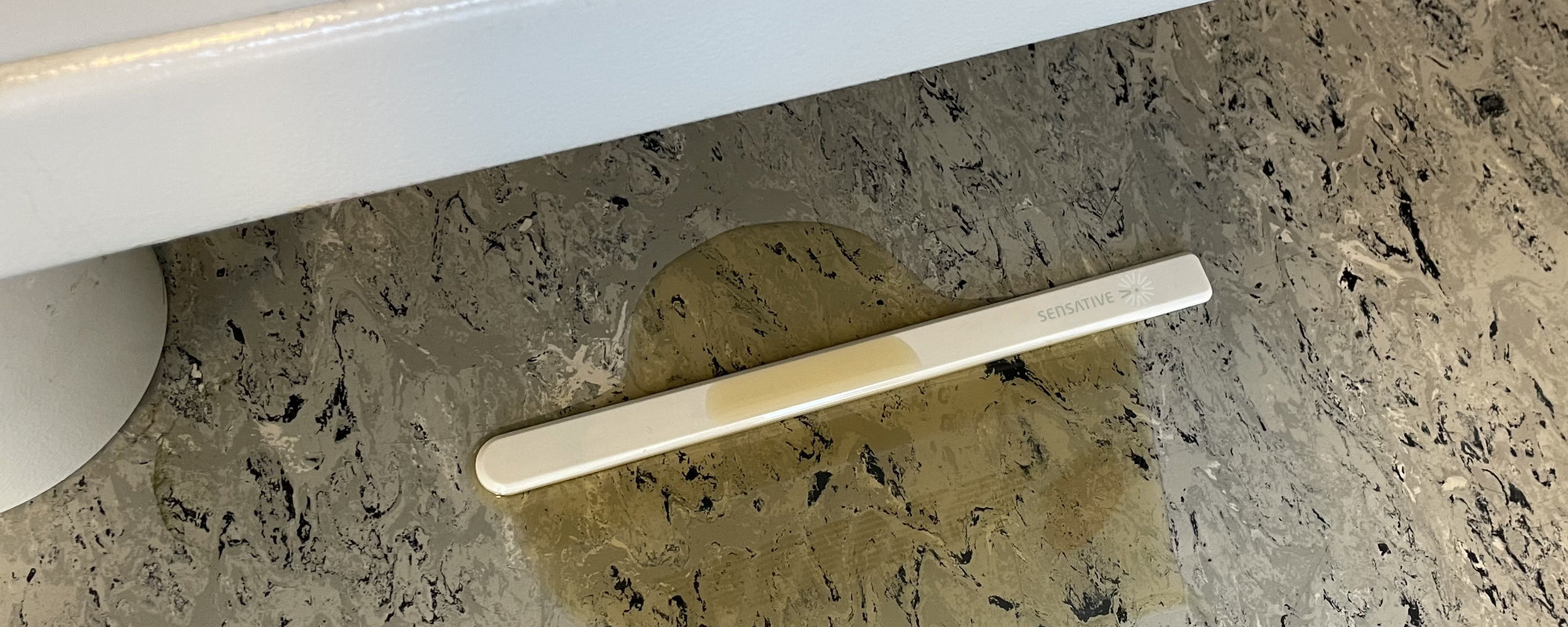
The cost case is unusually easy to state here. Technicians in Canada put a hydraulic jack replacement that has also leaked underground at US$30,000 to $60,000; the caisson has to be cleaned out or redrilled in 10 to 20% of those, adding US$30,000 to $100,000. The realistic range is therefore US$30,000 to $130,000 against a sensor in the pit.
One safety point belongs with it. A pit that has taken both water and oil can become somewhere a technician should not enter, between toxic gases and moisture meeting live electrics, so the alarm protects the person sent to look as well as the equipment. Beyond notifying maintenance, the Rule Engine can drive an out-of-order indication on the same event. Anything that interrupts the lift itself belongs to the lift's own safety chain and its inspection regime, not to a building platform bolted alongside it.
The absorber is a consumable
The alarm tells you what to bring before anyone sets off, which is the practical value of having two sensing areas rather than one.
| What alarmed | What it means | What you do |
|---|---|---|
| Open area only | Water, or another liquid the membrane turns away | Nothing to carry. The pads dry in a couple of hours and the sensor rearms itself |
| Both areas | Oil, or another liquid the membrane takes up | Take a spare oil adhesive. Replace it and clean the sensor, following Replace oil adhesive |
Water detection stays fire-and-forget. The consumable belongs to the oil event rather than to the product, so a site that never sees oil never replaces anything.
A water test does not spend it either. The oil membrane sits behind a metal foil that keeps water off it, so only hydrocarbons use it up - which means the whole alarm path can be commissioned and re-tested with water at no cost, on an oil sensor.
The chain behind the alarm
Everything from the alarm onwards is the same as for water, and it is where the value actually is - the sensor is the cheap part. Rather than repeat it here, see Water leak detection for the rule engine and escalation, acknowledgement and the timestamped audit trail, watching for sensors that have gone silent, and how to test the chain and keep it tested.
Two of those matter more when the liquid is regulated. The audit trail is what shows when you knew and what you did, which is the question asked afterwards. And watching for silence decides whether your coverage is real, because a dead sensor nobody notices is worse than no sensor - it is believed to be working.
How to get started
- List the places where a non-water liquid would be a problem, not the places that get wet. Bunds, containment, hydraulic plant, anywhere a spill becomes paperwork.
- Put a sensor at the point the liquid would reach, remembering that oil travels along surfaces rather than dropping straight down. Walk it with someone who has cleaned up after the last one.
- Set sensitivity per location. A wash bay and a transformer bund do not get the same setting, and this is what decides whether the alarm survives its first month.
- Decide the escalation before the sensors arrive, including who is told when the liquid is reportable and who records the time.
- Extend on evidence. The first incident, or the first season without one, tells you more than a checklist.
Related
- Water leak detection - the common case, and the shared alarm chain
- Strips Multi-sensor - the sensor hardware
- Rule Engine - building the alarm and escalation chain
- Reports - the coverage and incident evidence
- Warehouse racking - condition monitoring on the same platform