Water leak detection
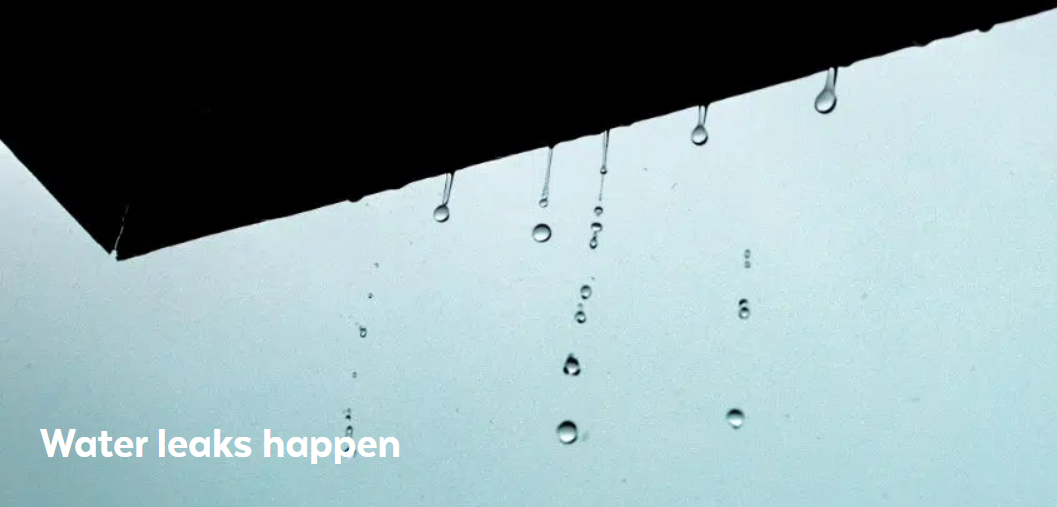
The leak that ruins a building is rarely the one that bursts. A burst pipe announces itself and the response is fast. A dripping coupling in a riser cupboard, a weeping valve behind a panel, condensate overflowing a tray - none of those announce anything, and by the time the damage is visible the cost is already committed.
So the problem is narrower than the phrase suggests. Pipes, seals and couplings will fail; you cannot prevent every leak. What you can decide is how long a leak runs before somebody knows. Every hour removed from that number is removed from the damage.
Why the exposure window is the whole measurement
Each way of finding leaks has a window during which a leak is running and nobody knows. The window is what separates the methods, not the accuracy.
| How leaks are found | What it actually catches | Exposure window |
|---|---|---|
| Inspection rounds | A leak visible at the moment someone walks past | The whole interval between rounds |
| Tenant or staff report | A leak that already has a noticeable symptom | Damage exists before the report |
| Moisture measurement in the structure | Damage, not the leak | Too late by definition |
| Flow or consumption metering | Large continuous loss on a metered line | Misses small leaks and non-water liquids |
| Wired float or point switch | Liquid at one point, where power and cable reached | Often not installed where the risk is |
| Wireless sensor at the collection point | Liquid arriving at the floor where you chose | Minutes, the reporting interval |
Only the last row is measured in minutes, and the reason is mundane: the sensor sits at the low point where liquid collects and reports on its own, with no cable, no power and no round to wait for. It does not replace inspection - rounds still find corrosion and a weeping joint above the sensor - but it removes the blind window between them.
What the sensor reports
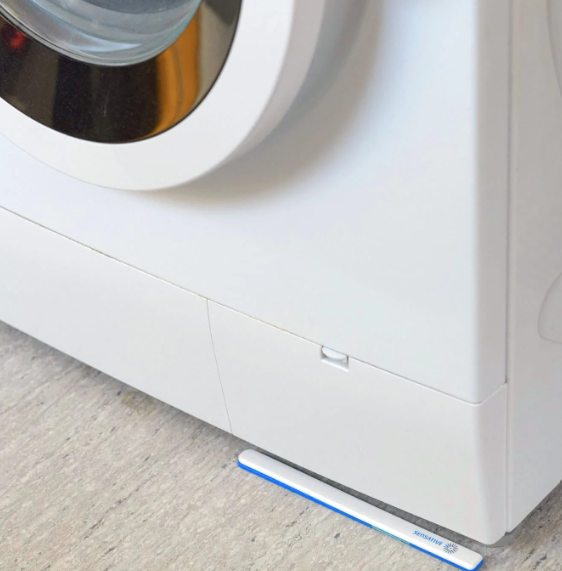
Strips MS +Drip is an under-3 mm strip that detects liquid by capacitance, through an absorbent pad that draws it in. See Strips Multi-sensor for the hardware detail.
| Strips MS +Drip | |
|---|---|
| Detects | Water |
| Also reports | Temperature, ±1.0 °C |
| Rearms itself | Yes, once the pads dry |
| Networks | LoRaWAN and Z-Wave |
It is thin, adhesive-mounted, and runs up to 10 years on a sealed battery. It needs no power and no cabling, which is what makes the coverage list honest: the reason coverage usually stops at a few locations is the cable.
If the liquid you are worried about is not water - hydraulic oil, coolant, diesel - that is a different sensor and a different problem. See Oil and other liquids.
Frost, from the same unit
+Drip reports temperature as well, so the same sensor warns before an unheated space reaches freezing - crawl spaces, attics, unheated garages, remote plant rooms, seasonal properties. A frozen pipe that bursts is the most expensive leak and the most preventable, so unheated spaces are worth a sensor whether or not they are on the leak list.
What it does not do
A leak sensor that is oversold gets switched off, so the limits are worth stating first.
| It does | It does not |
|---|---|
| Detect liquid arriving where the sensor sits | Find a leak that never reaches the sensor, or stays below it |
| Report within the configured interval, day or night | Measure a flow rate, a volume or a total loss |
| Warn before an unheated space freezes | Replace a dedicated climate sensor |
| Rearm itself once the pad dries | Tell you which liquid arrived - see Oil and other liquids |
Two consequences follow. Placement is the whole game - the sensor is reliable, the coverage is a design decision, and a walk-through with operations staff at the lowest point of each risk location is what makes it work. And sensitivity is a trade you own: higher sensitivity means earlier warning and more nuisance alarms, set per sensor, so a plant room and a server room are not set the same.
Where the sensors go
Start from your own claims and incident history. It names your risk locations better than any checklist, and ten well-placed sensors beat a hundred placed from a floor plan alone.
In buildings - under sinks and kitchenettes; behind dishwashers and washing machines; water heaters and boiler rooms; sprinkler valve rooms; riser cupboards and vertical shafts; district-heating substations; condensate trays under cooling and air handling; roof drains routed inside the envelope; lift pits; basement floors below grade; server rooms and their cooling; archives and stock rooms where the contents cost more than the floor.
From detection to an acknowledged action
A leak sensor without a chain behind it is a light in an empty room. The sensor is the cheap part; the chain is where the value is.
sensor  ->  LoRaWAN  ->  Yggio rule engine  ->  acknowledged
liquid      no cable,     who, how and         someone confirms;
reaches     no power      how urgently         the clock and the log stop
the strip
The Rule Engine is what decides the middle step:
- Different treatment by place and by hour. A server room at 03:00 is not a garage at 15:00.
- The alarm goes to a person, a group, an on-call rota, or into a work-order system, by email, SMS or webhook.
- The location is named the way your staff say it, not as a device identifier.
- Unacknowledged alarms repeat and escalate.
Acknowledgement closes the loop and stops the escalation, and every step is timestamped - raised, delivered, acknowledged, resolved. For a regulated liquid that record is what shows when you knew and what you did. Who is called at 02:00 becomes a rule in the system rather than a phone tree in somebody's head, and a rota change is made once, centrally.
Watching for silence
The failure mode of a leak sensor is silence, so the platform watches for that too. Battery level and radio quality are tracked for every sensor, and one that stops reporting is raised as a fault rather than left as a gap. A dead sensor nobody notices is worse than no sensor, because it is believed to be working.
What the team sees between incidents
Most days there is nothing to see, and the platform has to be useful anyway.
- Every sensor on a floor plan or map with its current state.
- Battery and signal health, so replacement is planned rather than discovered.
- A frost-risk view across unheated spaces through the winter.
- Alarm history per location. The places that keep alarming are telling you something.
Reports carry the same data outward: which risk locations are monitored, the uptime and battery health of that coverage, and an incident log with response times - which is the evidence an insurer or a board asks for. Documented monitoring does not transfer liability; it shortens exposure and documents diligence, and diligence you can document is worth more than diligence you can describe.
Recovery and consumables
The alarm tells you what to bring before anyone sets off.
Water detection is genuinely fire-and-forget. The pads dry within a couple of hours of the leak being dealt with, the alarm resets itself, and the sensor is armed again without anyone visiting it. There is nothing to carry and nothing to replace.
That is not true of an oil event, where the absorber is a consumable. See Oil and other liquids.
Testing the chain, and keeping it tested
An alarm path that has never been tested is a hope, not a control.
At commissioning, run a water test on every sensor with actual liquid rather than a simulated payload - the sensor dries out and rearms itself, so this exercises the whole alarm path at no cost. Test escalation by deliberately not acknowledging one alarm. Sign off per sensor as part of the acceptance test.
One timing constraint from Strips Multi-sensor: do not run the water test in the first two hours after the device joins. A second calibration runs at the two-hour mark, and wetting the sensor before it completes can leave the device unable to report later leaks.
As a routine, schedule an annual or seasonal test round from the rule engine itself, so the log shows it happened, on which sensors, and who confirmed. New staff and rota changes are the usual reason a chain quietly breaks. Between the tests, battery and link monitoring is what covers the gap.
How to get started
Start where the history points, not where a floor plan suggests.
- Take your own claims and incident log, pick the ten worst locations, and cover those. It names your risk better than any checklist, and ten sensors in cupboards that have actually flooded beat a hundred placed from a drawing.
- Walk those locations with operations staff and mark the lowest point in each, where liquid would collect. Add one unheated space for the frost case, since that leak is both the most expensive and the most preventable.
- Decide the escalation before the sensors arrive - who is called, how long they have to acknowledge, and who is called next. A sensor with no answer to that is a sensor nobody acts on.
- Run it for a season. You will learn both what leaks and how well the chain works, including the part where somebody is woken at three in the morning. See Testing the chain, and keeping it tested.
- Then extend on evidence rather than on a checklist.
A leak pilot is often how a property owner starts, and it is worth knowing that the platform is then already there for the next use case: the same Yggio instance carries presence, air quality, metering and building systems.
Related
- Strips Multi-sensor - the sensor hardware
- Rule Engine - building the alarm and escalation chain
- LoRaWAN - how the sensors reach Yggio
- Reports - the coverage and incident evidence