Internal mail collection
Large organisations still move paper between departments. Municipalities, hospitals and large companies run an internal mail service, and although e-mail, digital signatures and shared file storage keep reducing the volume, it does not reach zero - some documents stay on paper for legal reasons, and an analogue fallback is deliberately kept.
The volume falls. The round does not. Mailroom staff walk, cycle or drive to every outbox on a fixed schedule whether or not anything is in it, and as the envelopes disappear the proportion of wasted stops climbs. That is the whole problem: not the mail, but the journeys made to collect nothing.
The numbers make it concrete. A large municipality may have over 500 outboxes to empty, and a normal-sized one has 100 to 200, spread across a city centre, suburbs, villages and small local offices. Perhaps 30 to 40% of them hold nothing on any given round, and some see an envelope only a couple of times a year - but they are visited on the same schedule as the busiest box in the building.
What is measured
A sensor inside the outbox, reporting whether there is anything to collect.
Strips Presence is used here in object detection mode rather than the presence mode it runs in on a desk. The distinction matters, because the question is not "is a person nearby" but "is something lying in this box":
- It emits a low-powered infrared pulse at each poll interval and measures how much light comes back.
- When the reflection exceeds the configured threshold it reports
closeProximityAlarm = 1, and when it falls below half that threshold it reports0. Both are confirmed. - Detection range is up to 50 cm and configurable, so it can be tuned to the depth of the box rather than to a room.
The sensor is 3 mm thick and mounts with adhesive inside the outbox, under the lid or on the base, where an envelope placed in the box lands within its range. It needs no power and no cabling, runs up to ten years on its sealed battery, and reaches the network over LoRaWAN - which is what makes 500 boxes across a municipality feasible rather than theoretical.
From a schedule to a route
The reported state lands in Yggio as an ordinary device, so the rest is the platform: each outbox appears on a dashboard or map with its current state, and the round is planned from the boxes that have something in them.
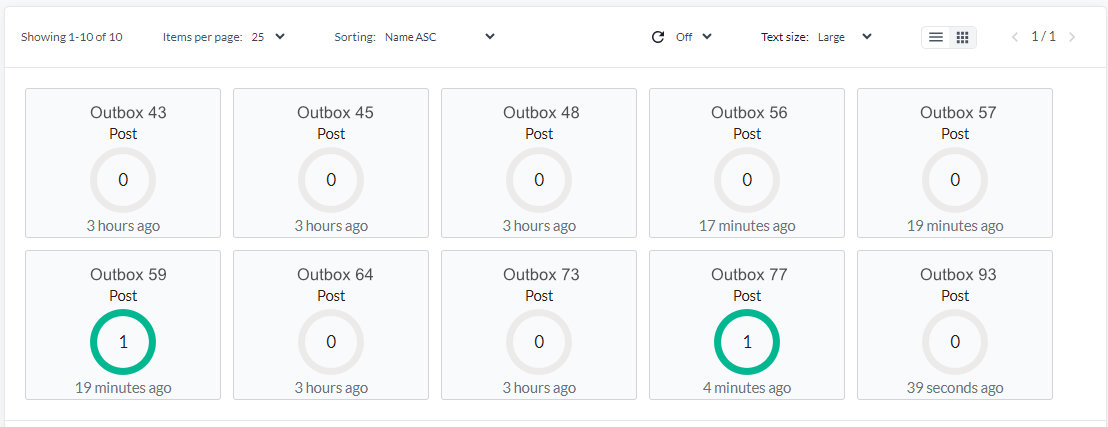
Two boxes waiting and eight empty is the ordinary picture, and it is the whole argument on one screen: the round visits two addresses instead of ten.
That is the entire operational change:
- Collect only where there is something to collect. The empty stops disappear from the route, which is staff time and vehicle distance rather than a reporting improvement.
- Deliveries get faster, not just cheaper. An envelope placed in a box at 09:00 no longer waits for the 13:30 round, because the round can be planned around where the work actually is.
- The far edges of the geography become affordable. A local office that sees an envelope twice a year is the worst stop on a fixed schedule and a trivial one on a demand-driven route.
The Rule Engine is what turns a reported box into an action: notify the mailroom, add a stop to today's route, or escalate a box that has been waiting longer than the service level allows.
It changes what the service can sell
This is often what pays for the deployment.
A fixed schedule can only promise a time. The sign on the outbox says the box is emptied every day at 13:30, and that is the entire product. Once the service knows which boxes have something in them, it can promise a response instead, and price accordingly - collection within the hour, before the end of the day, or by the following evening.
So an internal service that was a fixed cost becomes one with service levels and differentiated charging, and the sign on the box changes from a time to an SLA. The sensor pays for itself on avoided journeys; the pricing change is what makes the case comfortable.
What it does not do
| It does | It does not |
|---|---|
| Report that something is in the box | Count the envelopes, or say how many |
| Report within the configured interval, confirmed both ways | Know what the item is, or how urgent it is |
| Detect anything within its configured range | See an envelope that lands outside that range |
| Run for years with no power and no cabling | Replace the round entirely - some boxes still need a scheduled visit |
Two practical consequences. Placement inside the box decides reliability - the sensor has to face where an envelope actually comes to rest, which is worth testing in one box before ordering five hundred. And a box that reports nothing for months is indistinguishable from a box with a flat battery, unless you watch for that, which is why battery and link health per sensor matters more here than in a building full of sensors that report constantly.
Running it across a municipality
- Coverage before hardware. LoRaWAN carries a long way outdoors, but the boxes are indoors, in reception areas and corridors across a whole city. Confirm coverage at the awkward addresses before ordering for all of them.
- Name boxes the way the round does. The route is planned by people who know the building and the floor, not the device identifier.
- Track battery and last-seen per box, so a silent sensor is raised as a fault rather than read as an empty box.
- Keep a scheduled floor for the boxes that need one. Some locations have an obligation to be visited regardless; the demand-driven route runs alongside that rather than replacing it.
How to get started
- Take the round you already run and count the empty stops. That number is the business case, and the mailroom staff can usually give it to you from memory.
- Instrument one route end to end, not a sample of boxes across several. A route is only shortened when every stop on it is known.
- Test placement in one box first - where the envelope lands, what the threshold needs to be, whether the lid changes the reflection.
- Decide the service level before the sensors arrive. What the service promises is the thing the deployment changes; if that conversation has not happened, you have only saved some walking.
- Extend to the sparse edges next, not to the busiest buildings. The rarely-used boxes are where a fixed schedule costs most.
The same pattern applies wherever a fixed round collects something that is only sometimes there - waste and recycling being the obvious neighbour, where collection driven by fill level replaces a fixed route in exactly this way.
Related
- Strips Presence - the sensor, and its object detection mode
- Office utilization - the same sensor answering a different question
- Asset tracking - zones and counts, for things that move
- Rule Engine - turning a reported box into a route change
- Real estate - needs-based waste management, the same pattern